Why communicate scientific findings through visual stories?
More about myself
Scientific publication to communicate with peers.
Communication is an integral part of the research of every scientist, typically achieved through paper publications. Scientific papers are publications in scientific journals (and peer reviewed!) that share the original research with other scientists and researchers. In this way, these publications are a gauge of the scientific productivity in academia, being highly relevant for the scientists’ career path. Moreover, published papers in recognized journals strengthen the prestige of the research group and/or Institution. Most importantly, these publications aim to record scientific findings, enhance transparency and openness of the knowledge, as well as improve research integrity and reliability with information enough to be replicated and expanded by colleagues. Papers can preserve the knowledge and other scientists can build their research. Thus, paper publication are critical to the evolution of modern science.
Then why add figures to your papers? Scientific publications that contain attractive and informative figures can increase the reach rate, speed up the comprehension of the study and motivate the reader to get further in the manuscript. Thus, several scientific journals encourage to include figures in scientific papers. If you add attractive figures and understandable information, there are more chances that colleagues will be interested in your scientific findings, continuing the knowledge generation process.
However, the scientific knowledge belongs to whole humanity.
Therefore, it is fundamental to go outside the labs.
Science communication and outreach to broader communities.
On another side, the communication of scientific knowledge -including your own research findings- to broader communities is crucial for e.g. the implementation of evidence-based public policies, to apply effective, preventive and protective measures, especially under ecological and environmental changes. Thus, it is essential to communicate with society beyond the barriers of conceptual framework and language. Furthermore, shared knowledge is received and integrated by the community when this is shared under non-hierarchic view. To increase the trust in the scientific findings, implies validating the community’s existing knowledge and traditional practices, involving people in the process and deconstructing the ‘know-it-all’ attitude, among others.
In science communication (hereafter scicomm) there are a broad range of ways to build bridges between science and society. During the COVID-19 pandemic, podcasts, social media posts, got popular. Currently other formats such as standup shows, drag shows, and other performative arts approaches are getting attention. I know you visit my page mostly of my drawings, so you know I am going to focus on another approach: visual narratives.
Visual storytelling to communicate and connect with research.
As humans, storytelling is a fundamental tool to connect, allowing us to share experiences emotions and knowledge. In this way, we create bonds of mutual understanding, convey meanings and register our reality. In a global context, storytelling is a instrument that enables the co-construction of knowledge, connecting individuals as a collective in society. This has been alongside the human history, and storytelling can be oral, written and -for sure- drawn as visual narratives.
Visually attractive science plays a significant role in scicomm by captivating audiences further language limitations. Visual stories such as comics, graphic novels, murals, illustrations and even animation have been successfully designed as scicomm products for students, kids, and adults. Studies show that these formats can improve the understanding of scientific knowledge, bring memorable experiences, and create emotional and intellectual connections. Moreover, knowledge from these narrative formats is generally not imposed on the reader, who is an active participant in the story. This motivates them to get involved in the knowledge generation process and empower their own local knowledge.
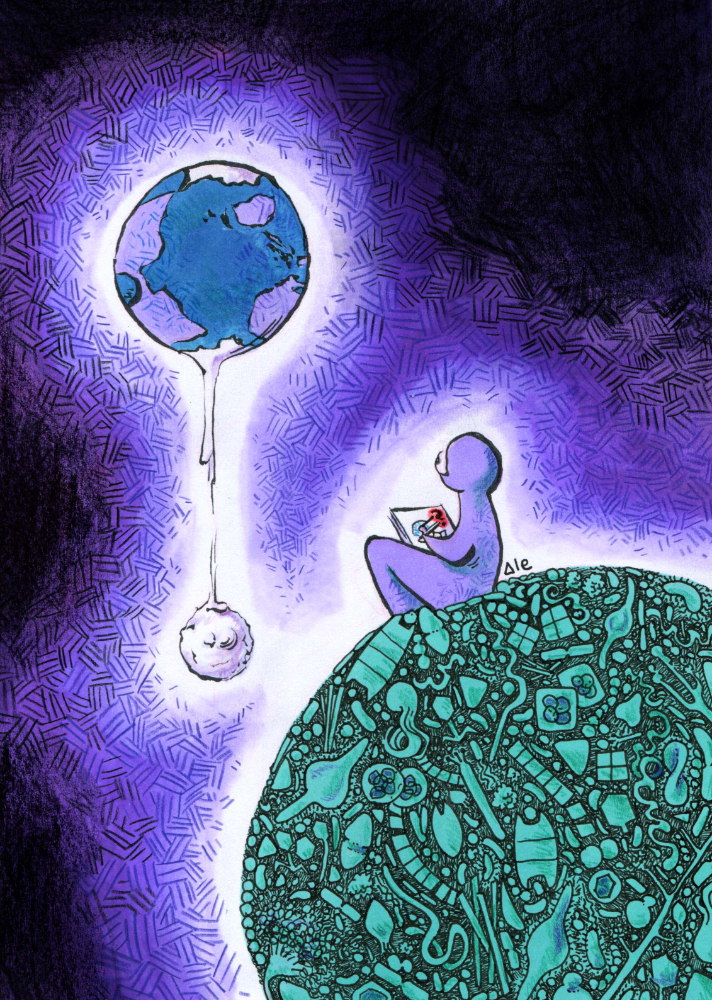
Infographics, descriptive illustrations and other related formats allow the reader to get the overall idea at first glance and delve into the topic by exploring each corner of the illustration. This allows to bring different levels of knowledge and connect in a different way with the audience.
To communicate approachable and understandable science allows the relevant knowledge transfer to decision-makers, as well as the public implementations’ grounds to the local communities involved. These important features of scicomm and outreach are also applied to pedagogic aspects in education, in which educational institutions are the key spaces where young audiences can connect with Science, Technology, Engineering, Arts, and Mathematics (aka. STEAM) fields.
Diverse views to expand our knowledge.
The knowledge generation aims to expand our understanding of reality, which is a fundamental process for human progress. However, this process gets limited when the humans involved in this process represent a restricted view of the diverse human realities. Thus, to integrate more and diverse perspectives in the process of knowledge generation, we increase understanding and expand our view of reality. But how to get involved if we do not even know is possible to be part of?
Our different cultural contexts influenced on our access to the scientific knowledge. When scientists from different backgrounds are active in research projects, it broadens the view scope, it can reduce e.g. the racial and gender stereotypes. Furthermore, when these scientists are visible and supported, can connect with their own communities to grow our relationships. This can increase the sense of belonging from the community to be an active part in the knowledge generation process. Consequently, to highlight the knowledge made by people can stand out diverse role models, encouraging the unrepresented population who are interested in studying science.
To sum it all up,
to communicate science is crucial to strength your scientists career path.
Moreover, to share the scientific findings allows to continue knowledge generation process
and democratize it to diverse communities, inside and outside Academia.

Illustration made for the book in Spanish “¿Puedo ser científica? Mujeres científicas estudiando ciencias”
(Can I be a scientist? Women scientists studying science), published by ArcanoIV editorial.
References:
Halpern, D. F. et al. (2007). The science of sex differences in science and mathematics. Psychological Science in the Public Interest, Supplement. doi:10.1111/j.1529-1006.2007.00032.x.
Jacobucci, D. F. C. & Jacobucci, G. B. (2009). Opening the test tube: What do we know about research on science communication and the teaching of microbiology in Brazil? Journal of Science Communication 8.
Long, M., Boiarsky, G. & Thayer, G. (2001). Gender and racial counter-stereotypes in science education television: A content analysis. Public Understanding of Science. doi:10.1088/0963-6625/10/3/301.
McKinney, D. & Michalovic, M. (2004). Teaching the Stories of Scientists and Their Discoveries. Science Teacher71, 46–51.
Mori, M. & Larson, S. (2006). Using biographies to illustrate the intrapersonal and interpersonal dynamics of science. Journal of undergraduate neuroscience education: JUNE : a publication of FUN, Faculty for Undergraduate Neuroscience 5, A1-5.
Peters E, Boyd P, Cameron LD, Contractor N, Diefenbach MA, Fleszar-Pavlovic S, Markowitz E, Salas RN & Stephens KK. (2022). Evidence-based recommendations for communicating the impacts of climate change on health. Transl Behav Med. May 25;12(4):543-553. doi: 10.1093/tbm/ibac029
Schaechter, M., Kolter, R. & Buckle, M. (2004). Microbiology in the 21st century: Where are we and where are we going https://www.asmscience.org/content/report/colloquia/colloquia.31.
Stout, J. G., Grunberg, V. A. & Ito, T. A. (2016). Gender Roles and Stereotypes about Science Careers Help Explain Women and Men’s Science Pursuits. Sex Roles. doi:10.1007/s11199-016-0647-5.